A GEUS–Equinor research project
OMGCCS
Optimized Monitoring of Ground and Surface Water for CCS
Knowing where, what, and how often to monitor above onshore CO₂ storage — protecting groundwater, meeting regulation, building trust.
Funded by INNO-CCUS / Innovation Fund Denmark
The challenge
Onshore geological CO₂ storage requires operators to demonstrate that no CO₂ or brine leaks beyond the storage complex — and public acceptance hinges on protecting drinking water and streams. But leakage effects in the near-surface are a needle in a haystack: highly localized signals that could appear anywhere across a large area, over decades of operation.
Conventional groundwater monitoring programmes cost 2–3 million DKK per site per year, potentially for 50 years. OMGCCS develops a model-informed methodology that answers where, what, and how often to monitor — reducing the number of monitoring locations, samples, and parameters by 35% would cut running costs by 73%, without compromising safety.
2–3 MDKK/yr
Typical monitoring cost per storage site
73%
Potential reduction in running costs
42 months
Project duration
The approach
WP1
Model the leakage pathways
Numerical models of CO₂ and brine migration from the reservoir along faults and legacy wells predict realistic leakage fluxes and where signals would first appear.
WP2
Measure what rock tells water
Laboratory experiments and field tests on local lithologies identify site-specific geochemical leakage indicators and their release rates.
WP3–4
A magnet into the haystack
Instead of dense grids of dedicated wells, monitoring targets that integrate signals from large groundwater volumes: water-supply wells and groundwater-fed streams. Reactive 3D transport models place each monitoring point where flow paths converge.
WP5
Machine learning on watch
ML anomaly detection flags subtle changes in the complex multiparameter monitoring stream over decades of operation — avoiding both missed events and false alarms.
AI-assisted geological modelling
The monitoring strategy is only as good as the geological model beneath it. OMGCCS builds a 3D model of the Havnsø–Stenlille area spanning from the storage reservoir up through the caprock, chalk, and overburden to the terrain surface — because that is the route any leak would take. The model integrates 14 depth-migrated seismic horizons and log data from 17 wells, and feeds an open-source simulation chain from full-field CO₂ injection to reactive transport along faults and wellbores.
The modelling workflow is AI-assisted and runs on a dedicated AI node at GEUS — confidential partner data never leaves GEUS infrastructure.
Open sourceThe full modelling chain runs on open-source simulation software — no proprietary lock-in.
The site
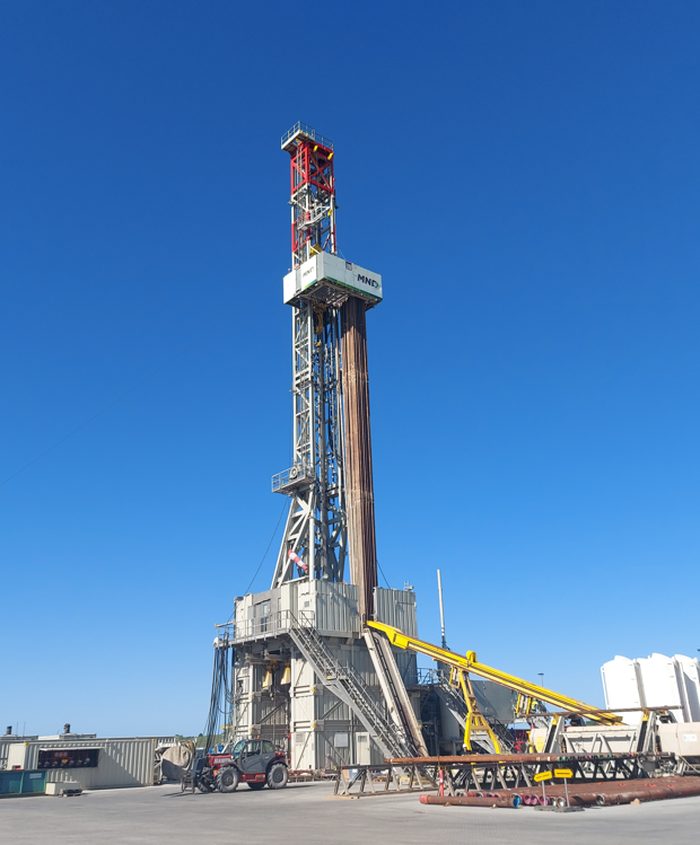
Work centers on Equinor's onshore CO₂ exploration license in the Kalundborg area, Zealand, Denmark — the Havnsø structure, with the Gassum Formation as the target reservoir. Decades of well and core data from the nearby Stenlille natural gas storage provide unique calibration, and new exploration data will become available during the project. The methodology is designed to generalize to other sites.
Work packages & team
| WP | Focus | Lead |
|---|---|---|
| WP1 | Numerical modelling of CO₂ and brine influx via faults and wells into groundwater | Nikolai Andrianov, GEUS |
| WP2 | Experiments on CO₂–rock interactions and signal-to-noise methods | Hanne Dahl Holmslykke, GEUS |
| WP3 | Reactive 3D transport models for optimizing monitoring locations, methods, frequencies | Rasmus Jakobsen, GEUS |
| WP4 | Produced waters and surface water as high-volume monitoring targets | Rasmus Jakobsen, GEUS |
| WP5 | Machine-learning model for optimized long-term monitoring | Julian Koch, GEUS |
| WP6 | Project management | Rasmus Jakobsen, GEUS |
Equinor
Project partner, holder of the Kalundborg onshore CO₂ exploration license
Partners & funding
 INNO-CCUSInnovation Fund Denmark
OMGCCS is funded by the INNO-CCUS partnership (Innovation Fund Denmark), addressing the mission theme “Monitoring and verification of CO₂ storage.”